Wishbone Bus Protocol: Signals, ACK, Pipelining, and VHDL
Learn the Wishbone bus protocol, its master-slave signals and ACK handshake, pipelined transfers, VHDL implementation, and differences from AXI.
What is Wishbone?
Wishbone is an open-source system bus developed by Silicore Corporation and standardized by the OpenCores Foundation. It is widely used in open-hardware designs (OpenCores, LiteX, OpenRISC) as an internal SoC bus.
Key characteristics:
- Open-source: free specification
- Simple: few signals, easy to implement
- Flexible: supports single, burst, and pipelined transfers
- Synchronous: all transactions occur on clock edges
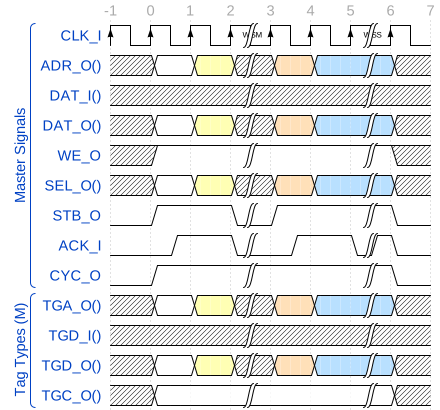
Wishbone Signals
Signals are prefixed _i (input) or _o (output) from the master's perspective.
| Signal | Direction (Master) | Description |
|---|---|---|
| CLK_I | Input | Shared clock |
| RST_I | Input | Synchronous active-high reset |
| ADR_O | Output | Address |
| DAT_O | Output | Data master → slave |
| DAT_I | Input | Data slave → master |
| WE_O | Output | Write Enable: '1' = write |
| SEL_O | Output | Active byte select |
| STB_O | Output | Strobe: active transaction on this cycle |
| CYC_O | Output | Cycle: master holds the bus |
| ACK_I | Input | Acknowledgment: slave completes the transaction |
| ERR_I | Input | (optional) Error |
| RTY_I | Input | (optional) Retry |
Read and Write Cycles